Minor Arcana · Cups · Five
Five of Cups

The Five of Cups tarot card meaning centers on grief, regret, disappointment, acceptance, and the slow return to what remains after loss.

- Suit
- Cups
- Rank
- Five
- Number
- Five
- Element
- Water

Five of Cups Tarot Card: Meaning, Reversed, Love & Career
What does the Five of Cups mean?
The Five of Cups means grief, regret, disappointment, or focusing on what has been lost. Reversed, the Five of Cups can show acceptance, emotional recovery, forgiveness, or the slow choice to turn toward what remains.
Five of Cups upright meaning
Upright keywords: loss, regret, grief
Upright, the Five of Cups is the card I handle gently. It does not ask you to be positive. It does not rush closure. It names the ache of looking at what spilled and knowing it mattered.
In the Rider-Waite-Smith image, a cloaked figure looks down at three fallen cups. Two cups still stand behind them, and a bridge waits in the distance. The figure cannot see those yet. Grief has narrowed the field of vision.
This card can appear after a breakup, betrayal, missed opportunity, painful conversation, or old regret that still carries weight. It asks for honest mourning, not performance. Something did not become what you hoped it would become. That deserves respect.
But the card also contains a quiet truth: not everything is lost. The two standing cups are not a command to move on immediately. They are a reminder that when you are ready, life will not be empty-handed.
Five of Cups reversed meaning
Reversed keywords: acceptance, moving on
Reversed, the Five of Cups can show the first turn away from pure regret. Acceptance begins, usually quietly. The story is still sad, but it is no longer the only story in the room.
Sometimes this card points to forgiveness — not as permission for harm, but as a way of releasing your own nervous system from constant replay. Other times it shows grief that has been avoided and now needs a safer place to move.
In love, the reversed Five of Cups may show someone beginning to release an old relationship, or recognizing that the lesson does not require lifelong punishment. In work, it can show recovering after a disappointment and choosing what can still be built.
The correction is compassion with accountability. Feel what spilled. Then, when your body is ready, look for the bridge.
Five of Cups in love and relationships
In love, the Five of Cups can show heartbreak, regret, disappointment, or focusing on what went wrong. It validates grief without turning it into fate. Reversed, it may show acceptance, emotional repair, forgiveness, or becoming willing to imagine love beyond one painful chapter.
Five of Cups in career and money
In career and money, the Five of Cups can point to disappointment, a missed opportunity, a failed plan, or regret around a choice. Reversed, it supports learning from the loss, salvaging what remains, and making the next decision from steadiness rather than self-punishment.
Five of Cups symbolism
The Five of Cups shows a cloaked figure facing three spilled cups while two remain upright behind them. A river and bridge separate the figure from a distant home. The image teaches that grief narrows attention, but it also leaves a path back to belonging when the person is ready.
Correspondences
- ElementWater
Five of Cups is attributed to Water in the Golden Dawn / Book T system.
Five of Cups tarot combinations
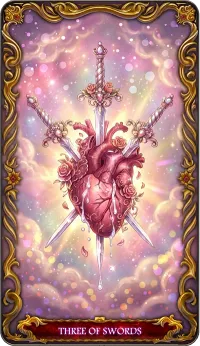 Five of Cups + Three of Swords: grief and heartbreak need honest witnessing.
 Five of Cups + Two of Cups: repair may be possible, but loss must be acknowledged first.
 Five of Cups + Six of Cups: old memories may intensify present regret.
 Five of Cups + Death: an ending asks to be grieved before transformation can settle.
 Five of Cups + The Star: hope returns after disappointment, not by denying it.
 Five of Cups + Eight of Cups: leaving may be part of healing, even when sadness remains.
A first-person reading example
In a reading, I would sit with the Five of Cups before trying to interpret around it. I would ask what you keep replaying, and whether regret has become a way to stay connected to what hurt you. If this is about love, I would honor the grief without telling you the story is over or not over. If it is about work, I would look at what can still be recovered. The cards show three cups spilled and two still standing. You do not have to turn before you are ready. But the bridge is there.
Frequently asked questions
Is the Five of Cups a yes or no card?
The Five of Cups does not give one fixed answer in every reading. Upright, it tends to support choices aligned with loss and emotional honesty. Reversed, it asks you to pause and look at where acceptance is shaping the situation.
What does the Five of Cups mean in love?
In love, the Five of Cups can show heartbreak, regret, disappointment, or focusing on what went wrong. It validates grief without turning it into fate. Reversed, it may show acceptance, emotional repair, forgiveness, or becoming willing to imagine love beyond one painful chapter.
What does the Five of Cups reversed mean?
The Five of Cups reversed often points to acceptance, moving on. It asks where the card’s water is blocked, exaggerated, avoided, or ready to be handled with more honesty and emotional maturity.
Is the Five of Cups a bad card?
The Five of Cups is not a bad card. It describes a real emotional pattern with useful and difficult expressions. The work is to meet the card honestly without panic, denial, or turning the symbolism into a fixed prediction.
What is the Five of Cups associated with?
The Five of Cups is a Minor Arcana Cups card associated with the element of water, the number 5, and the practical lessons of feeling, receptivity, relationship, intuition, and emotional clarity. The exact message still depends on the question and surrounding cards.
What does the Five of Cups mean for career?
In career and money, the Five of Cups can point to disappointment, a missed opportunity, a failed plan, or regret around a choice. Reversed, it supports learning from the loss, salvaging what remains, and making the next decision from steadiness rather than self-punishment.